
Ear · Procedure
Ear bone surgery: clearing disease from the bone behind the ear
Mastoidectomy in KPHB, Hyderabad
An ear infection that has gone on for months (chronic), or cholesteatoma, in the bone behind the ear.
Start with the symptom: An ear that discharges, and dulled hearing
- Operation time
- 2.5 to 3.5 hours
- Anaesthetic
- General anaesthesia
- Hospital stay
- Usually one night
- Rest at home
- About two weeks
Operation time: from going to sleep to waking up. The surgery itself is shorter.
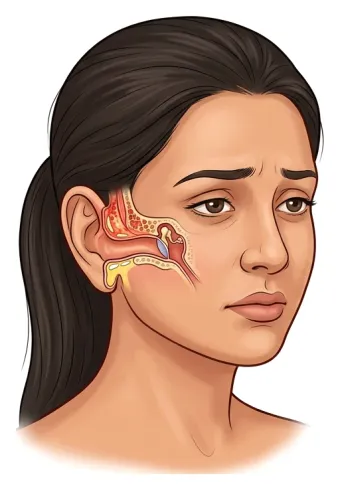
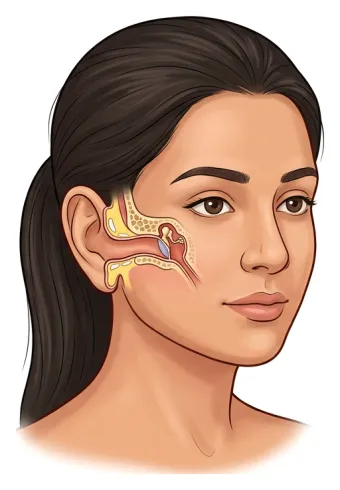
Mastoidectomy is planned at Sinocare ENT Hospital, KPHB Colony, Kukatpally, from a CT of the ear bone (temporal bone) and the hearing test. The mastoid is the honeycomb of bone behind the ear. It is joined to the middle ear. Sometimes infection, or cholesteatoma (a growth of skin trapped in the wrong place), spreads into it. Then no course of antibiotics reaches it. Mastoidectomy removes the diseased bone and the disease inside it, under a microscope, with a drill. Its first purpose is a safe, dry ear.
What the operation changes
How Dr. Santosh does it
Method
Microscope and drill, usually through a cut behind the ear
What usually happens
The operation is done while you are fully asleep (general anaesthetic), through a cut behind the ear. It takes two to three hours. Most patients stay one night. The stay is at Sinocare ENT Hospital, or at an associated hospital where an overnight bed or a larger operating room team is needed. You are told which at the first visit. You go home the next day, with a head bandage for a day or so and a pack in the ear. Stitches come out at about a week. The packing is removed in stages over the next weeks. Desk work at about two weeks. Hearing is judged only once the ear has healed, at two to three months.
When this is offered
- An ear that has been discharging for months or years, often with a foul smell
- Cholesteatoma seen on examination or on CT
- Hearing loss that is getting worse on that side
- An infection that clears on treatment and comes back as soon as treatment stops
- Warning signs of spread: dizziness, weakness of the face, severe headache, pain behind the ear
Cholesteatoma is not a cancer. But it acts in a way that has to be taken seriously. It eats away bone slowly, and it does not stop on its own. This is one of the few ENT conditions where the answer at the first visit is often surgery, without a trial of medicine first. The reasons are explained to you fully.
What the operation involves
The way in is usually through a cut behind the ear. Under the microscope, the mastoid bone is opened with a drill. The disease is cleared from every corner it has reached.
Two broad methods:
Canal wall up (closed). The back wall of the ear canal is kept. The ear looks and works more normally afterwards, and it does not need cleaning for life. But there is a higher chance of disease being left behind or coming back. So a planned second look is sometimes needed.
Canal wall down (open). The back wall is taken down. This makes a single open space (a cavity) that can be checked and cleaned at the hospital. There is less chance of disease coming back unseen. In exchange, the cavity needs cleaning once or twice a year for life, and the ear must be kept dry.
The right method depends on how far the disease has spread and on the state of the other ear. It also depends on whether you can come back for follow-up reliably. The eardrum and hearing bones are often rebuilt at the same time, or at a second stage.
Before the operation
- CT of the ear bone (temporal bone). It maps the disease before anyone picks up a drill. It shows where the disease sits against the nerve that moves the face (the facial nerve), the balance organ and the covering of the brain.
- A hearing test (audiogram) for both ears. The hearing in the other ear changes the plan.
- An MRI in some cases, where cholesteatoma that has come back must be told apart from scar tissue.
- A check that you are fit to be fully asleep.
Recovery after mastoidectomy
In hospital. A head bandage for the first day or so, a pack in the ear canal, and a drain in some cases. Pain is moderate and kept under control with regular painkillers.
First two weeks. The stitches behind the ear come out at about a week. Expect numbness around the ear and the upper part of the outer ear. It can last months. The ear stays dry, completely.
Weeks three to eight. The packing is removed in stages at follow-up. If the method was open, the cavity is cleaned and left to heal. This takes six to twelve weeks and needs several visits. Do not judge your hearing until it is done.
Long term. An open cavity needs a check and a clean once or twice a year, for life. That is not a complication. It is part of the operation you chose. That is why the method is discussed with you before surgery, not decided for you.
What we watch for
- Injury to the facial nerve. The nerve that moves the face runs through the area being operated on. In a diseased mastoid it is sometimes exposed or pushed out of place. It is the most serious risk of this operation, and it is uncommon. The CT maps the nerve beforehand, and the nerve is found and protected under the microscope throughout. Weakness, when it happens, may be temporary or permanent.
- Hearing loss, including, rarely, complete loss of hearing in the operated ear. Cholesteatoma itself damages hearing. Surgery removes the disease but cannot always bring back the hearing parts.
- Dizziness, usually for days. Now and then it lasts longer, if the disease has eaten into the balance organ.
- A change in taste on that side of the tongue, usually temporary.
- Disease that comes back, or is left behind, needing a second operation. This is not rare. With the closed method it is planned for, not treated as a failure.
- A cavity that discharges on and off after open surgery, managed by cleaning.
- Ringing in the ear (tinnitus).
Insurance and admission
Insurance. Insurance is accepted, both cashless and reimbursement, subject to the terms of your policy. Bring your card. The insurance approval (pre-authorisation) is handled for you.
Booking. WhatsApp is the fastest way. Send your reports as photographs. You will be told whether you need to be seen at the hospital in KPHB, and what to bring. Bring your CT of the ear bone and your hearing test. Also bring the medicines you take now, and your insurance card.
Questions patients ask
Can this wait?
Cholesteatoma should not be left for ever. It grows into bone at its own pace. What it grows into are the parts around it: the hearing bones, the balance organ, the facial nerve and the lining of the brain. Delay makes the final operation bigger, not smaller.
Will my hearing improve?
The first purpose of this operation is a safe, dry ear. Rebuilding the hearing is the second purpose. Sometimes it has to wait for a later operation, once the ear is free of disease. You should go in expecting safety first.
Will there be a visible scar?
It sits in the crease behind the ear and cannot be seen from the front. In most people, hair covers it within weeks.
How long off work?
Usually two weeks for desk work. Longer for physical work, and for anyone whose job involves dust or water.
Can I swim afterwards?
After a closed operation with a whole eardrum, often yes, once cleared. After an open cavity, usually not without a proper seal. If swimming matters to you, ask before the method is chosen.
Is this the “ear bone operation”?
Yes. The mastoid is the bone behind the ear, and the operation clears infection or cholesteatoma from it under a microscope. Its first purpose is a safe, dry ear.
Not sure you need this operation?
A consultation is allowed to end with "not yet".
WhatsApp us at +91 96765 24455