
Ear · Procedure
Otosclerosis surgery: freeing a stiffened hearing bone
Stapedotomy in KPHB, Hyderabad
A stiff hearing bone (otosclerosis).
Start with the symptom: Hearing loss in adults
- Operation time
- 60 mins to 90 mins
- Anaesthetic
- General anaesthesia, or local with sedation
- Hospital stay
- One day procedure, one night if dizzy
- Rest at home
- One to two weeks
Operation time: from going to sleep to waking up. The surgery itself is shorter.
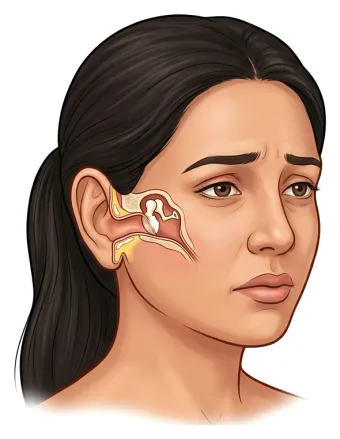
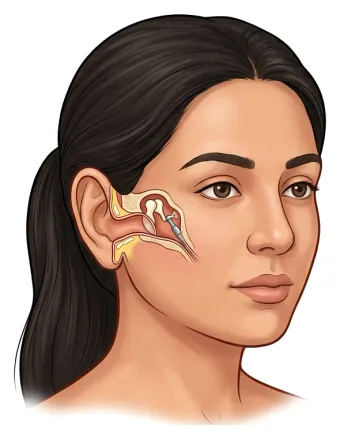
Stapedotomy is planned at Sinocare ENT Hospital, KPHB Colony, Kukatpally, from your own hearing test (audiogram). The hearing-aid route is discussed alongside it. The stapes is the smallest bone in the body. It is the last link in the chain that carries sound into the inner ear. In otosclerosis, new bone grows around its base (the footplate) and slowly freezes it in place. Sound stops being carried through, and hearing fades over years. Stapedotomy makes a precise opening in the fixed footplate. A tiny artificial part (a prosthesis) is placed there, and it takes over the movement.
What the operation changes
How Dr. Santosh does it
Method
Microscope, through the ear canal
What usually happens
The operation is done through the ear canal under the microscope. In most cases there is no cut on the outside. It takes forty-five minutes to an hour. You can be fully asleep (general anaesthetic). Or, for adults who prefer it, you can be awake with numbing medicine (local anaesthetic) and a sleepy medicine (sedation). Being awake lets your hearing be checked on the table. Most patients stay one night. The stay is at Sinocare ENT Hospital, or at an associated hospital where an overnight bed is needed. You are told which at the first visit. A pack sits in the ear canal for about two weeks. Hearing usually gets better once it is out. The result is judged on a repeat hearing test at six to eight weeks.
When this is offered
- Hearing that has faded slowly over years, usually starting in your twenties or thirties
- Hearing loss on the audiogram where sound is not carried through (conductive hearing loss), with an eardrum that looks normal
- A family history of hearing loss at a young age, which is common in otosclerosis
- Hearing that got worse during or after pregnancy
- Ringing in the affected ear (tinnitus), sometimes as the first symptom
Surgery is not the only option. A hearing aid corrects the same loss with no surgical risk. For some people that is the right answer, above all if the other ear does not hear well. Both routes are laid out properly before you choose. A good hearing ear is something you can lose and not get back.
What the operation involves
It is done through the ear canal, under the microscope, with no cut on the outside in most cases. The eardrum is lifted forward as a flap. The fixed stapes is separated from the chain of hearing bones. A small opening is made in its footplate. A prosthesis is placed from the middle hearing bone (the incus) down through that opening. Now sound vibrations reach the fluid of the inner ear again. The eardrum is laid back down. A pack goes in the ear canal.
It usually takes forty-five minutes to an hour.
Before the operation
- A hearing test (audiogram) with tuning fork tests. The pattern is typical, including a dip in bone conduction around 2 kHz.
- An eardrum pressure test (tympanometry). It usually shows a stiff eardrum that moves poorly, with no reflex.
- A CT of the ear bone (temporal bone) in some cases. It confirms the diagnosis and rules out conditions that look like it.
- A frank talk about the other ear. If only one ear hears well, that ear is not the one we operate on.
Recovery after stapedotomy
First week. Packing in the ear canal, a blocked feeling, and hearing that is no better yet. Some dizziness in the first day or two is common, and it settles. Feeling sick in the first hours happens, and it is treated.
Weeks two to four. The pack comes out at follow-up. Hearing usually gets better at this point, sometimes at once and clearly. Avoid blowing your nose, straining, lifting and flying for as long as advised. Changes in pressure are the enemy of a fresh prosthesis.
Six to eight weeks. A repeat hearing test. This is when the result is judged. Loud noise, contact sport and diving stay off until you are cleared.
What we watch for
This operation has a small risk of something serious. It is stated first rather than hidden, because it is the reason the decision is taken slowly.
- Severe or total hearing loss in the operated ear. Uncommon, but real, and it is permanent. This is why the better-hearing ear is not operated on. It is why a hearing aid is offered as a true alternative, not a second prize. It is also why the opening in the footplate is made as small and as precise as the microscope allows.
- Dizziness or a spinning feeling (vertigo). Common in the first days, now and then lasting. It is managed with rest and medicine.
- A change in taste on that side of the tongue. It comes from a nerve that crosses the middle ear, and it usually recovers over weeks to months.
- Tinnitus, which may get better, stay the same, or now and then get worse.
- The prosthesis slips, or the better hearing fades later. Then a repeat operation is needed, and it is harder than the first.
- A hole in the eardrum (perforation) or infection, which is uncommon.
Insurance and admission
Insurance. Insurance is accepted, both cashless and reimbursement, subject to the terms of your policy. Bring your card. The insurance approval (pre-authorisation) is handled for you.
Booking. WhatsApp is the fastest way. Send your reports as photographs. You will be told whether you need to be seen at the hospital in KPHB, and what to bring. Bring your hearing test, and the CT if one has been done. Also bring the medicines you take now, and your insurance card.
Questions patients ask
How much will my hearing improve?
The honest answer is this. The aim is to close the gap on the audiogram that is caused by the fixed bone. Any hearing loss from the nerve that you also have will stay. Your own audiogram shows how much of your loss falls into each part. That talk is specific to you. You will not be quoted a percentage from a textbook as if it were a promise.
Can both ears be done?
One at a time, with a gap of several months. And only after the first result is known and steady.
What if I do nothing?
Otosclerosis usually gets worse slowly. Hearing aids work well for it at every stage, and surgery stays an option later. Doing nothing does not close a door.
Is a hearing aid really as good?
For loudness, a modern aid gives back a great deal. What surgery gives that an aid cannot is hearing without a device. That matters for swimming, for sleep, and for people who cannot bear an ear mould. It also matters for those who simply do not want to wear one. That is the trade, against a small risk to the ear.
Will I feel the prosthesis?
No. It is a fraction of a millimetre of metal or teflon, and it moves as the bone it replaces did.
Is this the operation for otosclerosis?
Yes. Otosclerosis freezes the stapes, the smallest hearing bone. Stapedotomy makes a precise opening in the fixed footplate and places a tiny prosthesis that takes over its movement.
Not sure you need this operation?
A consultation is allowed to end with "not yet".
WhatsApp us at +91 96765 24455