
Throat and voice · Procedure
Adenoid removal: taking out enlarged adenoids in a child
Adenoidectomy in KPHB, Hyderabad
Mouth-breathing, snoring, blocked nose in a child.
Start with the symptom: Adenoids and tonsils in children

- Operation time
- 60 mins to 90 mins
- Anaesthetic
- General anaesthesia
- Hospital stay
- One day procedure
- Rest at home
- Three to five days off school
Operation time: from going to sleep to waking up. The surgery itself is shorter.
Adenoidectomy at Sinocare ENT Hospital, KPHB Colony, Kukatpally, removes an enlarged gland behind the nose (the adenoids). The decision rests on what the adenoids look like, not on the snoring alone. They sit at the back of the nose, where the nose meets the throat. You cannot see them by looking in the mouth. They are normal tissue that grows in early childhood and shrinks through the teenage years. Sometimes they grow big enough to block the back of the nose. Then a child stops breathing through the nose, and a lot changes with it. Removing them is a short, common operation. Most children are home the same afternoon.
What the operation changes
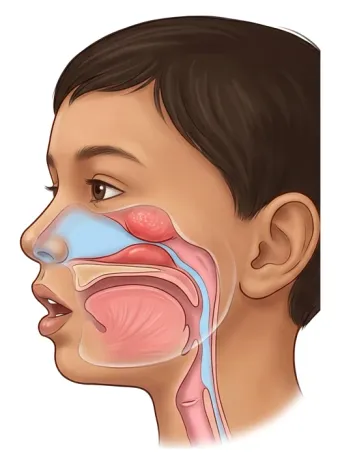
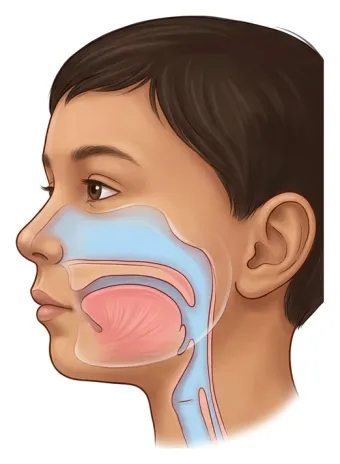
How Dr. Santosh does it
Method
- Dr. Santosh
- Coblation, with the adenoid seen through an endoscope
- Older method
- Curettage, the adenoid scraped away by feel without being seen
Cuts and stitches
No cuts outside and no stitches. Done through the mouth
What usually happens
The operation is done at Sinocare ENT Hospital with your child fully asleep (general anaesthetic). It is done through the mouth and takes fifteen to thirty minutes. Your child comes in the morning and has the operation. They wake in recovery with you nearby and drink within a few hours. Most go home the same day. There is a check-up in the first week or two. Most children are back at school within three to five days.
When this is offered
The signs parents describe, almost word for word:
- Snores every night, loud enough to be heard from another room
- Sleeps with the mouth open, neck stretched back, restless, sometimes sweating
- Pauses in breathing during sleep, then a gasp
- Wakes tired, is irritable in the day, is called inattentive at school
- Speaks with a blocked, nasal voice
- A nose that is always runny or blocked, and never fully clears between colds
- Repeated ear infections, or fluid behind the eardrum with hearing loss. Large adenoids block the tube that lets air into the ear. That is why so many children have both problems.
Adenoids shrink on their own with age. If a child is coping, waiting is reasonable. It is what most children with small adenoids are advised. The operation is for a child whose sleep is broken every night, or whose hearing and speech are affected. Even then, the sprays get a fair trial first.
Medicine first, and how far it goes
Adenoids are graded by how much of the airway they block, and the grade decides the treatment. Smaller adenoids are treated with medicine. Salt water (saline) sprays come first. A steroid nasal spray is added where the swelling keeps coming back or is inflamed. It is used the right way, and for long enough to judge. Surgery is for the child whose adenoids still block the airway after that. It is also for the higher grades, where the back of the nose is mostly blocked and no spray will change it.
What the operation involves
Your child is fully asleep. It is all done through the mouth, with no cuts on the outside and no stitches.
Coblation adenoidectomy, seen through a camera. The older way was blind scraping (curettage): the adenoid scraped away by feel, without being seen. A thin camera (endoscope) placed through the nose shows the adenoid bed directly. So the tissue is removed while it is seen, and the amount taken is chosen, not guessed. Coblation removes tissue at a fairly low heat instead of burning through it. That means less bleeding during the operation, and less pain afterwards, than the older methods.
It takes fifteen to thirty minutes. It is often done with small ear tubes (grommets) when there is fluid behind the eardrums. When the tonsils also block the airway, tonsillectomy can be done in the same sitting. Going to sleep once instead of twice is a real help for a small child.
Before the operation
- A look at the back of the nose, with a thin camera or an X-ray, to confirm the adenoids really are large. A blocked nose in a child has other causes, allergy most of all.
- A hearing test with an eardrum pressure check (tympanometry) where there are ear symptoms.
- A sleep study where the blockage sounds severe, or the child has other health conditions.
- Fasting exactly as told. It is the most common reason a child’s operation is put off on the morning, so the instructions are written down for you.
Recovery after adenoidectomy
The same day. Children usually wake with a sore throat and a nose that feels blocked. They drink within a few hours, and most go home the same day. Adenoidectomy alone is far easier than tonsillectomy.
Days 1 to 4. Sore throat, bad breath, and a blocked nose. The nose can feel worse than before, because the area is swollen. Some children have a nasal-sounding voice for a while. Soft food, plenty to drink, and paracetamol at regular times.
Week one. Most children are back to normal in three to five days, and back at school within a week. Breathing through the nose usually gets better in the first week or two, as the swelling settles. The change in a child’s sleep is often the first thing parents notice.
Avoid crowds and infections for a week, and swimming for as long as advised.
What we watch for
Every operation carries risks, and you are told them before you agree to it. For adenoidectomy they are uncommon, and each one has a plan attached.
- Bleeding. Uncommon. It usually happens at the time of surgery, and now and then in the days after. It is kept rare by removing the tissue while it is seen, and by controlling the area before the child wakes. Any significant bleeding from the mouth or nose at home means going to a hospital emergency department straight away. You are given that instruction in writing.
- Regrowth. Adenoid tissue can grow back, mostly in children operated on very young. Seeing the area with the camera, rather than scraping blind, leaves less behind. Now and then, a second operation is needed.
- A nasal-sounding voice. After removal, air can escape into the nose during speech for a while. It is usually short-lived and rarely lasts. It matters more in a child with a split in the roof of the mouth (a cleft palate). That is why the palate is checked before surgery.
- Neck stiffness or ear pain for a few days, settled with simple painkillers.
- Infection, uncommon, treated with antibiotics.
- The anaesthetic. The anaesthetist, the doctor who puts your child to sleep, goes through it with you beforehand.
Insurance and admission
Insurance. Insurance is accepted, both cashless and reimbursement, subject to the terms of your policy. Bring your card. The insurance approval (pre-authorisation) is handled for you.
Check your waiting period before you book. Many Indian health policies list this condition among “specific diseases” that carry a waiting period. It is commonly around two years from the start of the policy, even though the surgery itself is covered. Ask your insurer or TPA about the waiting period for this condition before you fix a date.
Booking. WhatsApp is the fastest way. Send your reports as photographs. You will be told whether your child needs to be seen at the hospital in KPHB, and what to bring. Bring the hearing test if one has been done, and any X-ray or endoscopy report of the adenoids. Also bring the medicines your child takes now, and your insurance card.
Questions parents ask
Are the adenoids needed for immunity?
They play a part in the first years of life. By the age this operation is usually done, the rest of the immune system covers the job. Children who have them removed do not catch more infections.
How young can a child have this?
From about the age of two, where the sleep or the ears call for it. Below that age, the decision is taken more slowly, and the nose is treated first.
Can we wait for the child to grow out of it?
Yes, if the child is sleeping and hearing well enough. Waiting is the usual first step. What tips the balance is a child losing sleep every night, or a hearing loss in the years speech is developing.
Will this also fix the ear problem?
Often it is part of the fix. Where fluid has already collected behind the eardrum, ear tubes are usually put in at the same time.
Will the snoring stop straight away?
Often within a week or two, once the swelling settles. If the tonsils are also large and were not removed, the snoring may go on.
Is it painful?
Much less than tonsillectomy. Most children need simple painkillers for two or three days. The low-heat coblation method is gentler on the tissue than the older methods were.
Why does an adenoid affect my child’s teeth?
A child who cannot breathe through the nose breathes through the mouth. Over years, that can change how the roof of the mouth and the jaws grow. It is one reason to treat a blocked nose in childhood rather than leave it. It is a slow change, not an emergency.
Is this the “adenoid removal” operation?
Yes. Adenoidectomy removes the enlarged adenoids at the back of the nose, and most children are home the same afternoon.
Not sure you need this operation?
A consultation is allowed to end with "not yet".
WhatsApp us at +91 96765 24455