
Throat and voice · Children
My child snores every night and breathes through the mouth
Child snoring and adenoids treatment in KPHB, Hyderabad
Most children who snore are treated without an operation. The ones who need one do very well.
Does this sound like you?
- Snores every night, loud enough to hear from the next room
- Sleeps with the mouth open and the neck stretched back
- Pauses in breathing, then a gasp
- Wakes tired, is cranky, cannot concentrate at school
- A blocked or runny nose that never clears between colds
- Repeated ear infections, or seems not to hear
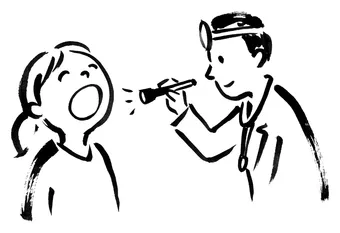
Child snoring treatment at Sinocare ENT Hospital, KPHB Colony, Kukatpally, starts with a look, not with a prescription. The look is at the gland behind the nose (the adenoids) and the tonsils. Children are welcome here, and this is the commonest reason a parent brings one. Take a child who snores every night, sleeps with the mouth open and wakes up tired. Usually the adenoids, the tonsils or both have grown large enough to crowd the airway. It is very common between the ages of two and eight. It is not the parent’s fault, and in most children it is managed without an operation.
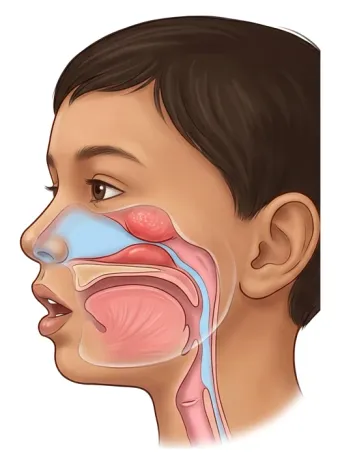
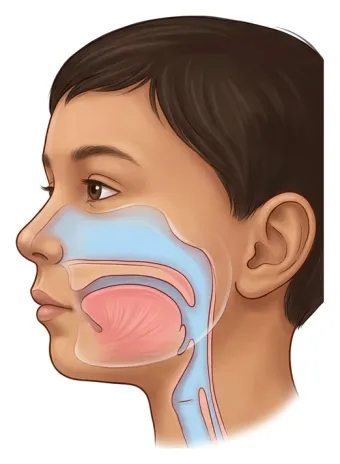
What it looks like inside
What it usually is
The adenoids sit at the back of the nose, where the nose meets the throat. The tonsils sit on either side of the throat. Both are normal immune tissue. It is at its largest in early childhood and shrinks from around the age of eight. In some children it grows faster than the airway around it. The nose blocks and the child breathes through the mouth. At night, when the muscles relax, the airway narrows enough to snore and sometimes to pause.
Allergy, a cold that never quite clears, and a bent wall between the nostrils (the septum) can add to the picture. That is why the examination looks at the whole nose and not only the adenoids.
What happens at the first visit
The visit for a child is a longer slot, because the parent has to understand the picture as well as the child. Dr. Santosh looks at the nose, the throat and the ears. Where a child will allow it, he passes a thin, flexible camera through the nostril for a few seconds to see the adenoids directly. Where that is not possible, an X-ray of the back of the nose shows them instead. If the ears look dull or the child seems not to hear, two tests are done at the hospital in KPHB. They are a hearing test and a tympanogram (a pressure test of the eardrum).
You leave knowing how large the adenoids and tonsils are, on a simple grade, and what that grade means for your child.
What helps, and what is tried first
For smaller adenoids, and for most children, treatment starts at home:
- Saline drops or spray into the nose, morning and night, to clear the mucus that makes the block worse.
- A steroid nasal spray, for a child whose swelling comes from inflammation or allergy. It is used correctly and for long enough to judge. You are shown how to aim it; most families have never been shown.
- Treating allergy where it is part of the picture.
- Sleeping position, and a humidifier in a dry room.
Many children improve on this and are simply reviewed as they grow. The adenoids shrink on their own with age, and waiting is a sound plan for a child who is coping.
When to come in sooner
- Pauses in breathing during sleep, several times a night
- A child who is falling asleep in the day, or whose behaviour at school has changed
- Speech that is delayed, or a child who says “what?” all the time
- Repeated ear infections, or fluid behind the eardrum on examination
- A child who is not gaining weight because eating is hard work
None of these is an emergency. They are the signs that the sprays will not be enough on their own. The next conversation should then happen sooner rather than later.
If an operation is ever needed
Some children still have adenoids or tonsils blocking the airway after a fair trial of medicine. For them, removing the adenoids or tonsils is a short, common operation done here by Dr. Santosh. The child is fully asleep (general anaesthetic). It is done through the mouth, with no cuts outside. Adenoids alone is a one day procedure, and most children are back at school within a week. Where the tonsils are removed too, the recovery is longer and the child usually stays one night. Small ear tubes (grommets) are added while the child is still asleep, where fluid has collected behind the eardrums. The pages below say exactly what happens, what the recovery is like, and what is watched for. Nothing is booked at the first visit unless the examination and the history both point the same way.
Questions parents ask
Is snoring in a child normal?
Occasional snoring with a cold is normal. Snoring every night, with mouth-breathing and restless sleep, is worth having looked at. It is common and it is treatable; it is not something a child should simply live with.
Will my child grow out of it?
Many do. The adenoids shrink from about the age of eight. The question is whether your child is losing sleep, hearing or growth in the years before that. The examination tells you.
Do the sprays actually work?
For smaller adenoids, yes, used correctly for six to eight weeks. The commonest reason they seem not to work is that they were aimed at the septum rather than along the floor of the nose.
Does my child need the tonsils out too?
Only if they are also blocking the airway, or if there is a record of repeated infections. Large tonsils in a child who sleeps well are left alone.
Is the operation safe?
Adenoidectomy is one of the safest operations in children’s surgery. Tonsillectomy is safe too, with a two-week recovery and a bleeding precaution that is explained in full. The risks and how they are managed are on each operation’s page, not hidden.
Does my child need an adenoid operation?
Most do not. Small adenoids are treated with a spray used correctly for six to eight weeks. The operation is for the child who is still losing sleep or hearing every night after that.