
Ear · Procedure
Ear tubes: draining fluid from behind a child's eardrum
Myringotomy and grommets in KPHB, Hyderabad
Fluid trapped behind a child's eardrum, dulling hearing.
Start with the symptom: Glue ear and a child who does not hear
- Operation time
- 30 mins to 60 mins
- Anaesthetic
- General anaesthesia
- Hospital stay
- One day procedure
- Rest at home
- One to two days off school
Operation time: from going to sleep to waking up. The surgery itself is shorter.
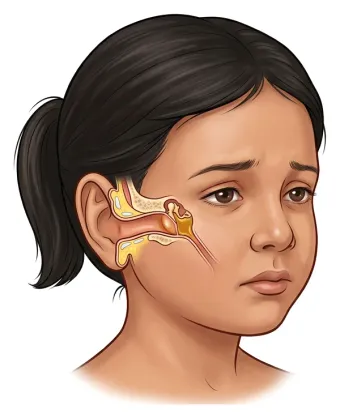
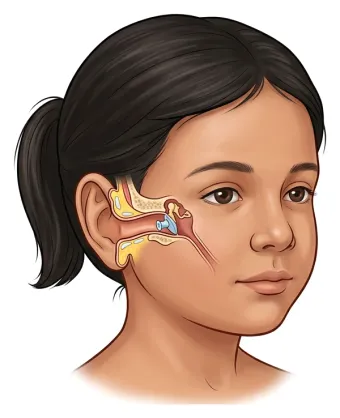
At Sinocare ENT Hospital, KPHB Colony, Kukatpally, the choice of small ear tubes (grommets) rests on two tests, not on age alone. They are the hearing test and an eardrum pressure test (tympanogram). A myringotomy is a tiny opening made in the eardrum. It lets out fluid trapped in the middle ear. A grommet is a small tube placed in that opening to let air in. It keeps the opening open so the ear can breathe. The grommet works its way out on its own as the eardrum heals, usually within six to twelve months. It is one of the shortest operations in ENT, and hearing usually gets better the same day.
What the operation changes
How Dr. Santosh does it
Method
Microscope, through the ear canal
What usually happens
It is done at Sinocare ENT Hospital while your child is briefly fully asleep (general anaesthetic). It is done through the ear canal and takes ten to fifteen minutes for both ears. Your child is in and out the same day. Most of the visit is getting ready for sleep and waking up, not the surgery. Back at school in a day or two. A hearing test a few weeks later records the change. Then there are check-ups until the grommet comes out on its own.
When this is offered
Glue ear is fluid sitting behind an eardrum that has no hole in it. It is common in young children. It usually clears by itself, and most children with it never need surgery. Surgery is considered when it does not clear, and it is costing the child something:
- Hearing loss on testing that has lasted for around three months
- Speech that is late, or a child who has started saying “what?” all the time, turning the television up, or seeming inattentive at school
- Repeated ear infections, several in a year, each needing antibiotics
- An eardrum that is pulled inwards and risks longer-term damage
- Ear pain when flying or at height
In adults, fluid behind one eardrum with no clear cause needs the back of the nose examined before anything else is done. That is a rule with a reason behind it.
What the operation involves
Your child is fully asleep. A microscope is used through the ear canal. The surgeon makes an opening a couple of millimetres across in the eardrum. The fluid is sucked out. It is often thick, which is where the name “glue ear” comes from. Then the grommet is seated in the opening. No cuts on the outside. No stitches.
It takes ten to fifteen minutes for both ears. Sometimes a gland behind the nose (the adenoids) is blocking the back of the nose, and that is part of the cause. Then the adenoids are often removed while your child is asleep for the same operation (adenoidectomy). That spares the child a second anaesthetic later.
Before the operation
- A hearing test that suits the age. A play hearing test (play audiometry), or, in the very young, an ear echo test (otoacoustic emissions) and an eardrum pressure test (tympanometry). A flat tympanogram is the clear proof of fluid.
- Three months of watching and waiting in most cases, with repeat tests. A good share of glue ear clears on its own and does not need an anaesthetic.
- A look at the nose and the back of the nose, above all if only one ear is affected.
- Nothing to eat or drink for the time the anaesthetist sets. The instructions are written down for you. Getting them wrong is the most common reason an operation is put off.
Recovery after grommets
The same day. Children usually wake grumpy, eat within a few hours, and are themselves by evening. Ear pain is mild. Paracetamol covers it.
The first week. In most children, hearing gets better at once. Sometimes the change is so big that the child says things are too loud. A little blood-stained discharge for a day or two is normal. Back to school in a day or two.
Water. Everyday bathing and hair-washing are fine with sensible care. Diving, deep swimming and putting the head under water wait until the ear has been checked and you are told it is safe.
Follow-up. A hearing test after a few weeks records the change. Then there are check-ups until the grommet comes out. Once it is out, some children need a second set. Most do not.
What we watch for
- Ear discharge through the grommet, above all after a cold or if water gets in. It usually settles with antibiotic drops, and you are given a plan for this.
- The grommet coming out early, with the fluid returning and a second operation needed.
- The grommet staying in too long and having to be removed. That is why the check-ups go on until it is out.
- A small hole left in the eardrum after the grommet comes out, in a minority of children. Most close on their own. One that stays open can be repaired later.
- Scarring or thinning of the eardrum. It is common to see, and it rarely affects hearing.
- The anaesthetic itself. Anaesthesia for children today is very safe. The anaesthetist, the doctor who puts your child to sleep, will talk it through with you directly.
Insurance and admission
Insurance. Insurance is accepted, both cashless and reimbursement, subject to the terms of your policy. Bring your card. The insurance approval (pre-authorisation) is handled for you.
Booking. WhatsApp is the fastest way. Send your reports as photographs. You will be told whether your child needs to be seen at the hospital in KPHB, and what to bring. Bring the hearing test and tympanogram, the medicines your child takes now, and your insurance card.
Questions parents ask
Can we wait instead of operating?
Often, yes, and waiting is the usual first step. The reason not to wait for ever is this. Hearing in the years a child is learning to speak is time that cannot be won back. The case for waiting gets weaker if speech is already affected. It also gets weaker if the hearing loss has been tested over three months without change.
How young can a child have grommets?
From about the age of two. The hearing test and the tympanogram decide it, not the age alone.
Will my child need this again?
Some children need a second set of grommets. It is more likely in children who are still very young at the first operation. It is also more likely where the adenoids were not dealt with.
Does the grommet have to be taken out?
No. It is made to be pushed out by the eardrum as it heals, usually within six to twelve months. It often falls out without anyone noticing.
Will it hurt my child’s ear permanently?
Grommets usually leave marks on the eardrum that can be seen but do not affect how it works. Glue ear left untreated for a long time does more to an eardrum than a grommet does.
Can it be done without general anaesthesia?
In adults, sometimes, with numbing medicine (local anaesthetic). In children, no. The ear canal is small, the target is millimetres across, and the child must keep perfectly still.
Are grommets the same as “ear tubes”?
Yes. A grommet is a small tube placed in the eardrum to let air in. It works its way out on its own as the eardrum heals, usually within six to twelve months.
Not sure you need this operation?
A consultation is allowed to end with "not yet".
WhatsApp us at +91 96765 24455