
Ear · Children
My child doesn't seem to hear, and keeps getting ear infections
Glue ear treatment for children in KPHB, Hyderabad
Most glue ear clears by itself. The hearing test tells us which children need help sooner.
Does this sound like you?
- Says "what?" all the time, turns the television up
- Speech is slower to come than expected
- Ear infections every few months
- Seems inattentive at school, or tired
- Pulls at the ears, or complains they feel blocked
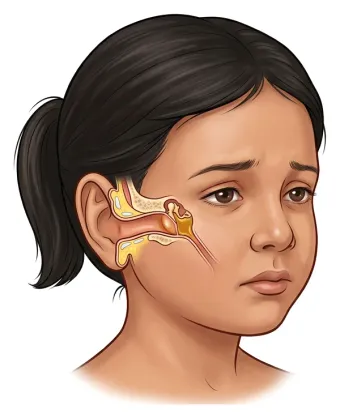
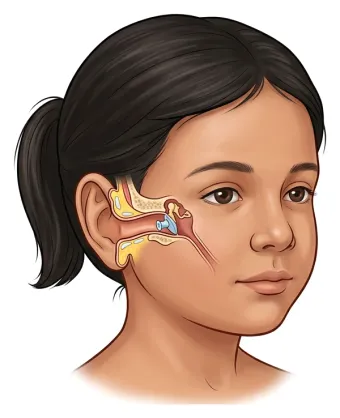
Glue ear treatment at Sinocare ENT Hospital, KPHB Colony, Kukatpally, starts with a hearing test and a tympanogram matched to the child’s age. Glue ear is fluid sitting behind an eardrum that has no hole in it. It is one of the commonest reasons a young child does not hear well. It usually follows a run of colds or ear infections. In most children it clears on its own within a few months. It matters because it happens in the years a child is learning to speak. A child who cannot hear clearly cannot copy sounds clearly.
What it looks like inside
What it usually is
The middle ear, behind the eardrum, gets its air through a narrow tube to the back of the nose. In young children that tube is short and easily blocked. A cold can block it, or allergy, or a large gland behind the nose (the adenoids) sitting over its opening. When it blocks, the fluid the middle ear makes cannot drain, and it thickens. The eardrum stops vibrating freely, and sounds arrive muffled, as if underwater. Infections come more easily in a wet middle ear. That is why the two problems travel together.
What happens at the first visit
The ears are examined under magnification, with a microscope or a small ear camera (endoscope), not a torch. Glue ear has a typical look. Then come two tests, both done at the hospital in KPHB and both easy for a child to sit through. One is a hearing test matched to the age. The other is a tympanogram, which measures how freely the eardrum moves and shows whether fluid is there. The nose and the back of the nose are examined too, because the adenoids are so often part of the cause.
You leave knowing whether there is fluid, how much hearing it is taking, and what the plan is.
What helps, and what is tried first
For most children, the plan is to watch and test again:
- Three months of watchful waiting, with a repeat hearing test. A good share of glue ear clears in that time without any treatment.
- Treating the nose: saline, and a steroid spray where allergy or the adenoids are adding to it.
- Simple things at home: speaking face to face, reducing background noise, telling the school.
- Treating each infection as it comes, with antibiotics where they are needed.
When to come in sooner
- Speech that is delayed, or has stopped progressing
- Hearing loss confirmed on testing that has lasted around three months
- Several ear infections in a year, each needing antibiotics
- An eardrum that looks pulled in on examination
- Ear pain with flying
If an operation is ever needed
Some children’s fluid has not cleared after three months, and it is holding back their hearing. For them, small ear tubes (grommets) are the answer. A tiny opening is made in the eardrum to let the fluid out. A small tube is placed in it to keep air reaching the middle ear. It is one of the shortest operations in ENT: ten to fifteen minutes for both ears. The child is briefly fully asleep (general anaesthetic) at Sinocare ENT Hospital. Hearing usually improves the same day. Where the adenoids are blocking the tube, they are removed while the child is still asleep. That way the child does not need to be put to sleep a second time. The ear tube works its way out on its own within a year.
Questions parents ask
Is my child’s hearing damaged for good?
No. Glue ear causes a hearing loss that is temporary and mechanical. When the fluid goes, on its own or with an ear tube, the hearing comes back.
Do we have to operate?
Usually not. Waiting is the first step for most children, and it works for many of them. The hearing test decides whether waiting is still the right plan.
Will my child need grommets more than once?
Some children do, mainly those who were very young the first time, or whose adenoids were not dealt with. Most do not.
Can my child swim with grommets?
Ordinary bathing and swimming at the surface are fine with sensible care. Diving and putting the head under wait until the ear has been checked.
Is glue ear the same as an ear infection?
No. Glue ear is fluid sitting behind an eardrum with no hole in it, usually after a run of colds or ear infections. It takes hearing rather than causing pain. It follows the infections rather than being one.