
Throat and voice
I snore loudly and stop breathing in my sleep
Snoring and sleep apnoea treatment in KPHB, Hyderabad
Snoring is common. Apnoea is treatable. A sleep study at home tells the two apart.
Does this sound like you?
- Loud snoring, and a partner who has seen you stop breathing
- Waking unrefreshed however long you slept
- Falling asleep in the day, at a desk or at traffic lights
- Waking with a headache or a dry mouth
- High blood pressure that is hard to control
Snoring and sleep apnoea treatment at Sinocare ENT Hospital, KPHB Colony, Kukatpally, starts with a sleep study, done at home, before anything is decided. Snoring is the sound of a narrowed airway vibrating during sleep. It is common, and by itself it is a nuisance rather than a danger. Obstructive sleep apnoea is when the airway narrows so far that it closes. Breathing stops for seconds at a time and oxygen falls. The brain surfaces to reopen the airway, dozens of times a night, without the sleeper knowing. From the next room the two sound the same. A sleep study, done at home, tells them apart, and that is where this starts.
What it looks like inside
What it usually is
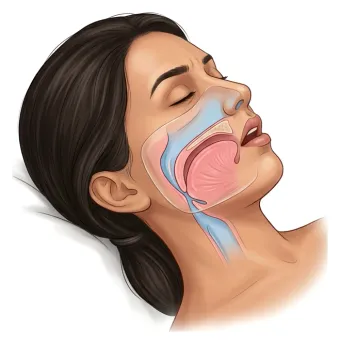
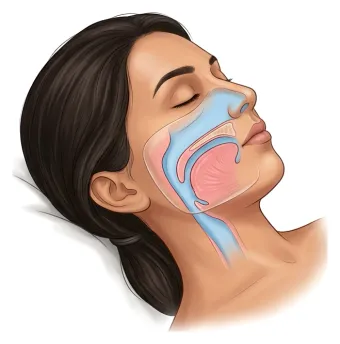
During sleep the muscles that hold the throat open relax. Some airways are narrow: from a blocked nose, large tonsils, a long soft palate, a heavy neck or a set-back jaw. In a narrow airway the relaxed tissue vibrates, and snoring is the result. When it collapses completely, that is apnoea. Untreated apnoea is linked with high blood pressure, heart disease, stroke and diabetes. It is also linked with the daytime sleepiness that causes road accidents. Treated, those risks fall.
In children the picture is different. The cause is usually the gland behind the nose (the adenoids) and the tonsils; see adenoids and tonsils in children.
What happens at the first visit
The history comes first, with your partner’s account if they can come. Then the airway is examined from the nose to the voice box with a flexible camera, in the chair at the hospital in KPHB. It shows where the airway is narrow: the nose, the palate and tonsils, or the base of the tongue. Neck size, weight and blood pressure are noted. If the story suggests apnoea, a sleep study is arranged. For most people it is a small monitor worn for one night in your own bed. For some it is an overnight study in a sleep laboratory. Either one measures how often breathing pauses and how far oxygen falls. Nobody is treated for apnoea, and certainly nobody is operated on for it, without one.
What helps, and what is tried first
- Weight and sleeping position. Losing weight reduces apnoea in many people, sometimes enough to change the treatment. Sleeping on the side rather than the back helps most snorers. Simple as they sound, they are the only treatments that address the cause.
- Opening the nose: allergy treatment and sprays, where a blocked nose is part of it.
- Alcohol and sedatives in the evening relax the airway further, and cutting them helps.
- CPAP, for moderate and severe apnoea. It is a mask worn at night that holds the airway open with gentle pressure. It works in nearly everyone who wears it; the whole difficulty is wearing it. A proper trial with mask fitting comes before anyone is told surgery is the alternative.
- A mandibular advancement device, a dental splint that holds the jaw forward, for some snorers and milder apnoea.
When to come in sooner
- Pauses in breathing witnessed by someone else
- Falling asleep while driving, or nearly
- High blood pressure that medicines are not controlling
- Snoring in a child with mouth-breathing and restless sleep
If an operation is ever needed
There is no single operation for sleep apnoea. What is done depends on where the airway collapses, and the sleep study and the examination decide it. Opening a blocked nose is often the first step. It often makes CPAP bearable for someone who could not use the mask. Removing large tonsils widens the throat, and so, in selected people, does trimming the soft palate. Dr. Santosh does these operations. He also says plainly that surgery may not cure apnoea on its own. Some people still need CPAP afterwards, at a lower pressure. A repeat sleep study is how the result is measured. That honesty is the point of the visit.
Questions patients ask
I only snore. Do I need a study?
If you wake refreshed and nobody has seen you stop breathing, possibly not. If either of those is not true, yes.
Can I have surgery instead of CPAP?
Sometimes: for the person who truly cannot use a mask, and who has a blockage that can be removed. It is not a straight swap. The sleep study afterwards shows how much it did.
Is a home sleep study as good as one in a lab?
For most people, yes, and it is done in your own bed. A lab study is arranged where the home study is unclear or other sleep problems are suspected.
Will losing weight fix it?
It often improves it a great deal. It is the hardest advice to follow, and the only one that treats the cause. So it is offered alongside everything else, not instead of it.
Where can I get a sleep study done?
It is arranged from the hospital. For most people it is a small monitor worn for one night in your own bed; some need an overnight study in a sleep laboratory.